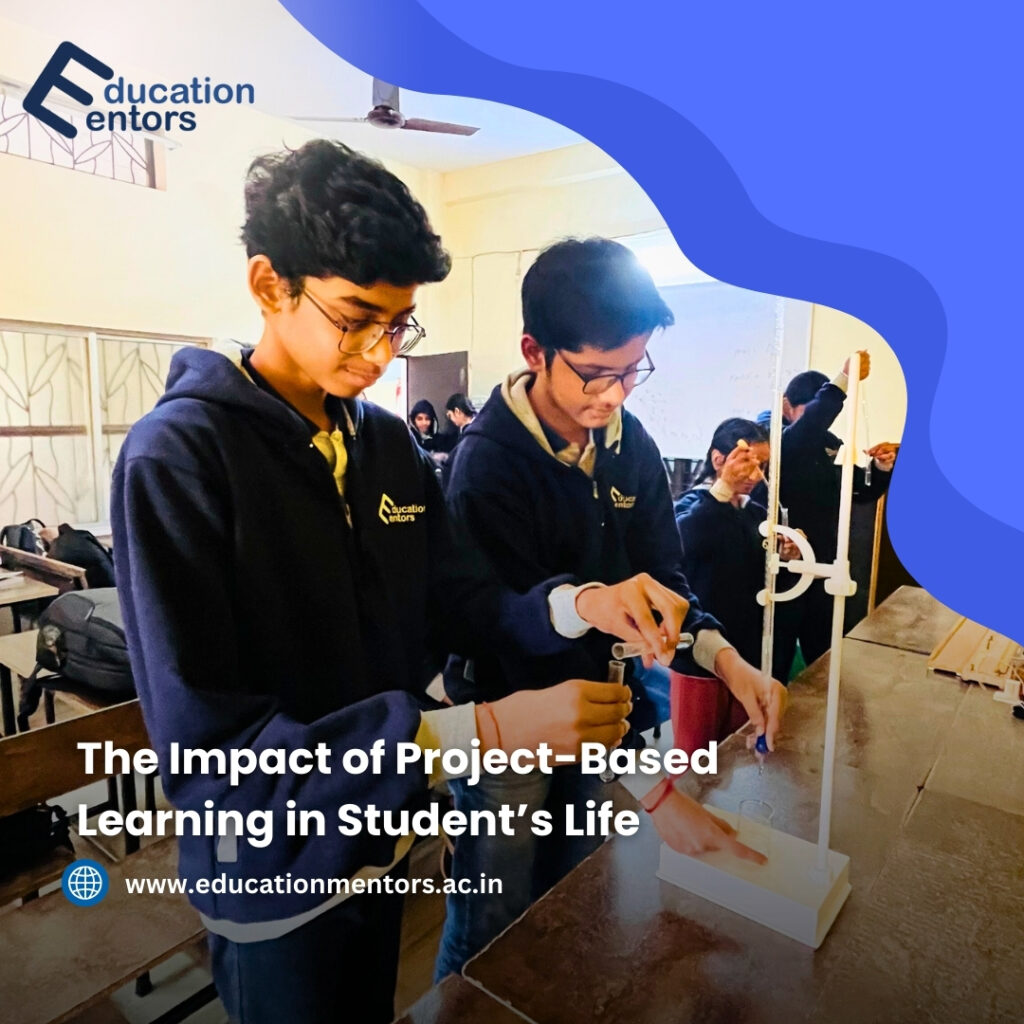

A student sits in class, watching a teacher solve a numerical problem on the board. Every step feels logical. The formula makes sense. The method seems straightforward. By the end of the explanation, the student is convinced that the concept is clear.
A few hours later, the same question appears on a study table at home.
The notebook opens. The question is copied. The first line is written and then nothing happens. The mind goes blank.
If this sounds familiar, you are not alone. Students preparing for school exams, board exams, JEE, NEET, and other competitive examinations experience this all the time. What makes it frustrating is that the problem often has very little to do with intelligence or understanding. In many cases, students genuinely know the concept. The challenge lies somewhere else.

For prepration of JEE / NEET visit : https://educationmentors.academy
Read our other blogs :- The Impact of Project-Based Learning in Student Life
The Real Problem Is Not the Question

When a teacher is solving a problem in class, students are following a path that has already been created. The direction is clear. Each step naturally leads to the next one. Even difficult questions feel manageable because someone else is guiding the thinking process. At home, that guidance disappears.
The student must decide where to begin, which formula to use, and how to connect the information provided in the question. Suddenly, the responsibility for the next step belongs entirely to the learner. This is where many students get stuck.
If you look through rough notebooks, you will often notice the same pattern. The question is written neatly. A formula may be noted down. Then the page remains empty. The issue is rarely a lack of knowledge. More often, it is the challenge of generating the first step independently.
Understanding Is Not the Same as Performing
Many students mistake recognition for mastery.
They can follow a solution when someone explains it. They can understand the logic when they see it on a board. They may even feel confident enough to say, “I understood everything.” But understanding a solution and creating one are two different skills.
Imagine watching a professional cricket match. You may understand the rules, recognize good strategy, and predict what a player should do next. That does not automatically mean you can walk onto the field and perform under pressure.
Academic problem-solving works in a similar way. Watching solutions helps learning. Creating solutions develops performance. Exams do not test whether students can recognize the correct method after seeing it. They test whether students can generate that method on their own.

The Hidden Cost of Constant Hints

Modern students have access to more educational resources than any previous generation. Video lectures, solution manuals, discussion forums, and AI tools can provide answers within seconds.
While these resources are incredibly valuable, they can sometimes create an unintended habit.
The moment a student encounters difficulty, help becomes available immediately. Over time, the brain begins to expect it.
Instead of sitting with a problem, exploring possibilities, and tolerating uncertainty, many students learn to seek the next hint as quickly as possible. The result is that problem-solving endurance gradually weakens.
Learning is not only about receiving information. It is also about developing the ability to think through confusion. That ability grows only when students spend time struggling productively with a challenge.
Why Productive Struggle Matters
There is a common belief that struggling with a question means something is wrong. In reality, struggle is often evidence that learning is taking place.
When students attempt to solve a problem independently, the brain is forced to retrieve concepts, test ideas, identify mistakes, and evaluate different approaches. These mental activities strengthen understanding far more effectively than passive observation.
Research consistently shows that effortful recall and active problem-solving improve long-term retention. The moments that feel difficult are often the moments that create the strongest learning.
This does not mean students should spend hours stuck on a single question. It simply means that immediate solutions should not always be the first response to difficulty.
A Simple Approach That Works

When you feel stuck on a numerical problem, resist the urge to look at the solution immediately Instead, begin with three simple questions:
What information is given?
List every value, condition, or detail provided in the question.
Which formula or concept might apply?
Even if you are not completely sure, write down the possibilities.
What is the first logical step?
Do not worry about the entire solution. Focus only on the next move.
This approach reduces pressure because it shifts attention away from the final answer and toward the thinking process. Very often, once the first step becomes clear, the rest of the solution starts to unfold naturally.
Build the Habit of Independent Thinking
The next time you solve numerical problems, try a small experiment.
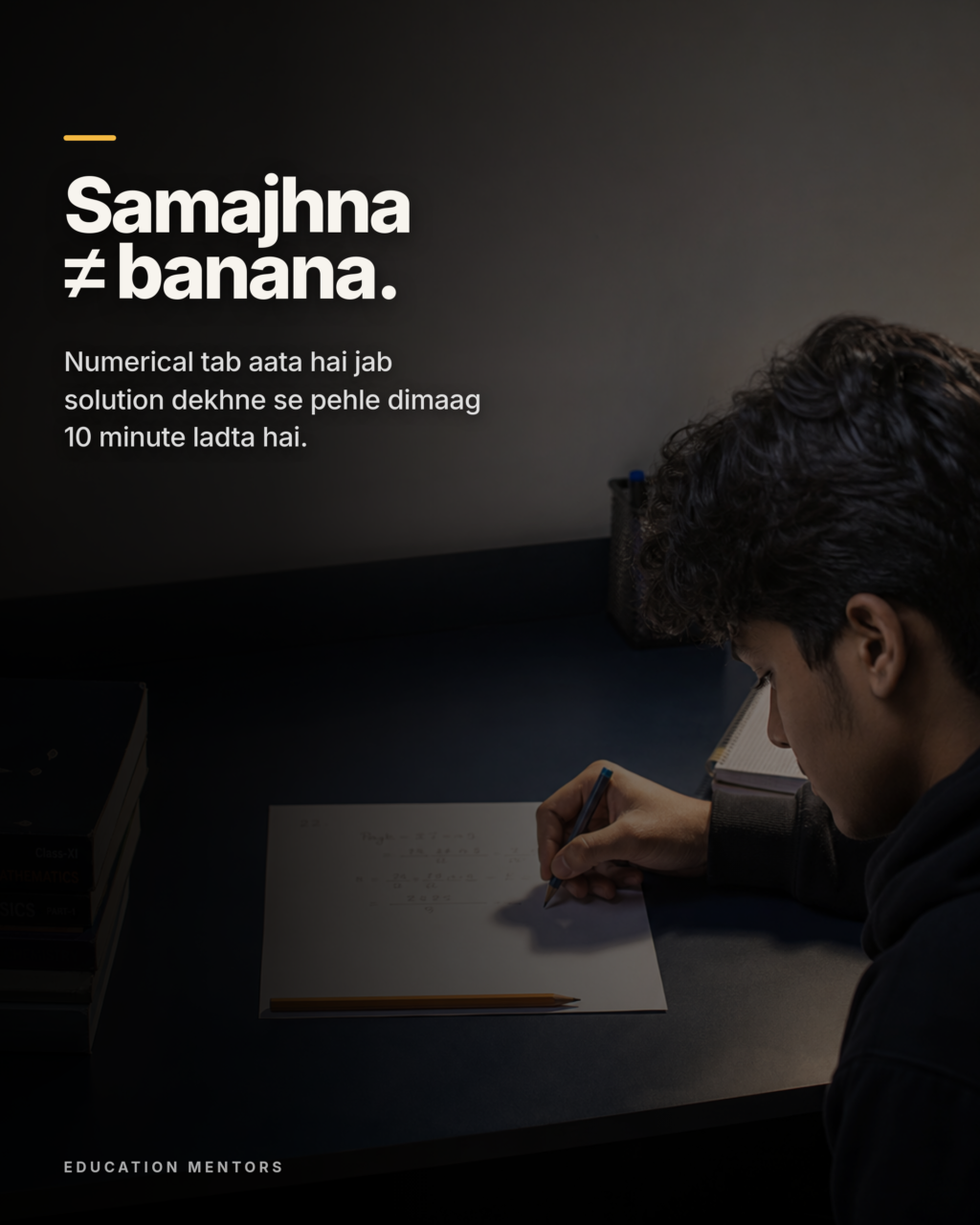
Before checking any solution, spend at least ten minutes working on the question yourself. Write down ideas. Test different approaches. Make mistakes. Erase them. Try again.
Not every attempt will lead to the correct answer, and that is perfectly fine. The goal is not to get everything right immediately. The goal is to train your brain to think independently.
Even solving three questions a day this way can create a noticeable difference over time. Students who develop this habit often become more confident because they learn that uncertainty is not something to fear. It is simply part of the learning process.

Final Thoughts
Classroom understanding is an important beginning, but it is not the finish line.
Real confidence develops when a student can sit alone with a rough sheet of paper, face an unfamiliar problem, and still know how to begin. The ability to think through a challenge is far more valuable than the ability to recognize a solution after seeing it.
So the next time a question feels impossible, avoid rushing to the answer. Give your mind a chance to wrestle with the problem first. You may not solve it immediately. But that struggle is often where the real learning begins.